Tuesday, 23 October 2018

Evidence Based Practice

Yesterday, I was told to savour each day's learning rather than just eating a lot. I liked that idea. Because learning takes a different shape when given enough time to reflect on, and form consolidated applicable information. 

I applied the 3 pillars of evidence based practice to the couple who had been referred for adult vaccination by Dr Rao. Not that I had never applied, but I never had the time to actually reflect on what were the arguments in each pillar I was applying. The pillars being-
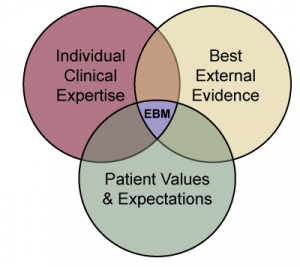
Related image


The wife was 62 yrs and husband 69 yrs. They had their wonderful family physician Dr Rao who had referred for vaccination to us. They actually expressed while taking history how they approached him for every health issue and felt safe. That reminded me of my grandfather who also was practicing family medicine doing home visits with his suit case. Those days I thought he was old fashioned but now when I don't have a family physician myself, I'm starting to requestion myself.

Since they were elderly, and the husband had chronic lung condition, I wanted to offer them pneumococcal and Influenza vaccine. As I knew they were coming, I got some time to look up on the guidelines and literature. So my dilemma was-

After 65 yrs, one is given PCV13 followed by PPSV 23 after a year to enhance the seroconversion and protection levels for the common strains. But for those adults less than 65 yrs just one shot of PPSV23 is recommended. Eventually when they turned 65 and beyond, they have to be given PCV13 as well. And a few studies showed that giving PCV 13 followed by PPSV23 was better rather than the other way round. So I was confused whether to give the wife just PPSV23 or start with PCV13.

That's when RK asked me to apply the 3 pillars. According to my clinical judgement, it made sense to start with PCV13 as she was close to age 65. I explained the same to her and she was happy to go with that logic. Thus the completion of the 3 pillars.
I'm yet to read up on the efficacy and other aspects of the adult vaccines and the same will follow in my next post.

Wednesday, 15 August 2018

An Honest Reflection


All my life I've been in the path of Conventional Education System. I excel in that, undoubtedly. Was given the title "Best in class" in primary school classes (due to marks, not exactly best otherwise. Because I can recall a lot of smart friends from school) Best is always relative to what we're referring to.
Then I switched to CBSE syllabus for high school which I was given freedom to choose. So that's the first effort I remember being put where I learnt by myself before the classes of high school started just to be at par with the students who were in CBSE in their primary school too (because state syllabus hadn't actually taught me to think critically). Anyway, high school passed and PU went studying as well as dreaming about what I wanted to be. The desire to be an excellent Math Teacher changed into being a doctor as differentiation and integration started making less and less sense to me in real life (but I understand the potential of these topics now). Also those were the times I started being sensitive towards the issues in the society, inequality, the times I was scientifically curious.

In my second year of MBBS when the clinical postings started, I was posted to surgery department first and I remember the day I was posted to the dressing room discretely. We saw so many feet that were gangrenous, some with a few toes missing, making their lives miserable. And the indirect cause being uncontrolled blood sugar levels. It was unsettling. On further probing, I learnt that most of them became aware that they were having diabetes only after a wound in their foot refused to heel. That's when I respected the value of preventive Medicine. I wanted to screen all elderly for Diabetes and keep their sugars under control, educate them and prevent amputations. That was a dream. Was the screening idea feasible? Cost effective? Well, I didn't and still don't know. But that's when I started loving community medicine and public health. I really wanted to do make a difference to the community. I believe health care to be a basic modality of life and that being said, it not being available to all is unacceptable.


Those days, I used to take walks with my father, and I asked him a lot of questions. One such morning, I asked him who makes changes in the system? He said Government, but IAS officers are the ones who are brainy and who are change makers, who execute necessary actions. That's when I thought I should become an IAS officer. (Later some other day, the family had a chat, which made me realise that's not the only way to make a difference.)


I worked clinically well during my internship and tried to keep my options open just to see if I fell in love with any particular department or specialty. Although I loved treating and taking care of patients I couldn't imagine myself just doing that in future. So by the end of internship, when friends had a good plan of preparing for the entrance exams to become clinical specialists, I was searching for an organisation to work and learn more about public health. That's when I joined SVYM and HIV fellowship as mentioned in my previous post.

But what has all this got to do with what I'm currently doing? Now, I've come out of the conventional path. And it's not easy in multiple ways. Leaving all the new city part aside, I'm working with really smart people around. The work culture is so rich that I'm both excited and scared at the same time. It's very different from the kind of work or learning I'm used to. People are collaborating, doing great things at a great speed. They have such multiple sets of skills in the places I'm working both at NCBS and at PCMH. So I've to speed up and learn a lot of things.

Under this Indo-African Initiative, I can actually learn by doing a lot of things with these people. Expectations from me are as stated here  .
But to sum it up, I've to take a lead in collecting, analysing data, (epidemiological), learn up sequencing and other molecular biology techniques required for independently running tests at the field level. In the process I'll be meeting and learning from some amazing people from the fields of Fundamental Science, Molecular Biologists, Clinicians, Epidemiologist in India and Africa. I'd learn epidemiology in it's practical sense both in the field and in the lab!

For this, I should be ready to start learning all the skills that I always wanted to learn. Because if I want to make any kind of difference in health care like I've been wanting to since years, I need a bundle of skills. Now that I have the right mentors and people around me, I should fear less and get to it!

Who cares if I fall in the bus or break my laptop? Or get nervous looking at a bunch of smart people around a conference hall during presentation? It doesn't matter if one's not perfect to start with but one must not lose the ability to learn. Because, "if it doesn't challenge you, it doesn't change you."
So, I've signed up to a few online courses on coursera like - Epidemiology, Maps and geospacial revolution, R programming, Metagenomics etc. And will be immersing myself in growing. 


Friday, 10 August 2018

The Beginnings

So, it's been a week since I started work and life in Bangalore.
I just finished my exams of fellowship in HIV medicine and people ask me, what next? It's everyone's favourite question, including myself.
The very reason I joined that fellowship was because it was offered at a great organisation, "Swami Vivekananda Youth Movement" which mainly works for the tribal health, education and socio-economic empowerment. I chose to work at Vivekananda Memorial Hospital because I could learn both clinical medicine and community health as the hospital integrates community health, preventive medicine in day to day patient care. Also as a step towards a career in public health I felt and was told by one of my mentors Dr Sumanth MM, it would be a good place to learn from, to build better attitude and contacts of course.
I'm proud of making the decision as it gave me a different perspective of public health. It taught me that public health is not a different domain in health but is an integral part of praticing medicine even if it's done at a clinic. It gave me an opportunity to learn the social, cultural aspects of illness, and how to spontaineously think about them while caring for your patient even during a busy OPD like Dr Seetharam, the orthopedician and President of SVYM does.

During the fellowship, we had many case presentations and a few journal presentations. On one such days we were introduced to Dr Ramakrishna Prasad and his team about which my friend Dr Akshay has written with much clarity here. I should again be grateful to SVYM because it attracts such wonderful people to the organisation. He has now become my mentor.

So with his mentorship, I've joined as a Clinical Research Fellow at NCBS, Bangalore under an Indo-African Initiative. So RK thought I would be a right choice for this work as I had showed up to a "Health Researchers' meet" at NCBS which was conducted as a step towards working in collaboration and not silos in research field. Like they say "80% of success comes by just showing up". I could learn about this meet only because of another mentor who I value Dr Ananth Kumar who was attending this as well.

I've also joined his team - PCMH-Restore Health as a clinician/HIV consultant where I'll be able to care for patients too.

So what's the kind of work I do everyday? Why did I choose it? 


Thursday, 24 August 2017

With the community

I haven't written in a while. Today I had to write for several reasons. Mainly because I realised how my new place of work and study is influencing my mind and way of thinking. I've been asked to keep a daily log during the entire course of my fellowship in HIV medicine at SVYM, Viveka Memorial hospital, Saragur which started a week ago. I'm glad that'll make me write regularly so that I jot down the crazy amount of thoughts and learnings I'm experiencing in SVYM before I forget a few of them. Also I believe writing brings clarity and forces one to learn things in detail. So what was different that compelled me to write?
I had duty in the mobile health unit (MHU) today. This is a service 5 days a week from our hospital where a doctor and a field worker goes to around 8 haadis each day (different ones fixed each day) in a van which has drugs to treat some common ailments. It's a concept which I had previously come across even at the hospital at BR hills about which I've already written. The tribal settlements were called podus at BR hills while they are named haadis here. So this mobile health unit is an operation that sounds simple but is quite extensive and wonderfully insightful in terms of how much effort is being put by many people to bring about outcomes that are beyond treating the diseases.
Briefly this is how it works in our setup:  (I still have to learn about the logistics in detail)
A field worker is given the responsibility of few haadis.So all the people in those haadis are his/hers. He/she'll take care and know about almost everyone from their place. He visits them, gets information regarding the number of eligible couple, pregnant ladies, neonates, infants, their immunisation status, the number of TB patients whether suspected, or on treated or completed treatment. Finds out about the problems if any, that they are facing related directly or indirectly to their health and socio-economic condition. Be it their job, or getting their ration/ aadhar card. So before the MHU actually reaches their haadi on their respective days, the field worker would know who should be paid attention to by the doctor. When we go in the MHU van, a siren is played to which some people come to discuss their ailments and get treated. But there are people who would be sleeping unwell and would reveal only when we go to their home and ask "yellaru channagidira?" (meaning is everyone okay?). Like my friend who was here from the US had rightly pointed out that hospital is for the people who are willing and can approach health care facility,camps are for the people who can't approach the health care facitlity and MHU is for the people who won't seek health care. :D So we take a round and ask people randomnly about their health and try to pull in people to the van not to abduct them but just to keep them healthy.
What I realised today is -
  • SVYM has and is building a bond with the community it is working with through various means and MHU is one big operation that is facilitating this, especially for the tribal community who are resistant to approaching a health care facility or personnel without that bond and trust. "With" being highlighted because this is the exact same word that one of the founders used while discussing with a well wisher  the other day. About how SVYM is not working for the people but with the people. 
  • I was eager to see and was able to follow up the patients I'd seen in our hospital and keep a track of how they are doing even if they weren't coming for follow up.
Also we were taught during our community posting during UG times to take a detailed history regarding the conditions that led a person to develop a disease. But here we can witness the person in his actual living environment, in his daily routine. The water he/she is consuming, the food a mother is feeding an undernourished child daily, the kind of defecation practice one is following, in real without the need of questions. In this way we can understand why some conditions if not all, we term as "preventable events" occur.
For example, today we found a pregnant lady smiling. She basically approached the van because she was having pain in her lower abdomen since the past one week. So I asked her a basic question of how many months old was her pregnancy. She giggled and confronted that she didn't know and thought it had been 7 months and that her husband knew. Then I asked her to get her mother card suspecting that she hadn't had enough ANC visits. So she came back hiding the card in her veil. She had probably visited just once to a PHC, maybe to get the card and so only Hb , weight and blood grouping was written. Somehow she was immunised with 2 injections of TT one in the PHC and the other in our MHU itself. No scan done. Not screened for HIV/HbsAg/VDRL as every pregnant lady is. She was smiling all the while until I started probing her to tell me why she hadn't visited for Ante natal care or for ultrasonography to know the health status of her growing baby. She had tears in her eyes and told us how her husband barely has money left over after pouring it all into liqour. He is least interested to share the responsibility in taking care of his  baby or carrying wife. She had no parent and her only brother was elsewhere working. So she was completely dependent on her husband for money and care. So we gave her 50 rs asking her to take the bus this Sunday to our hospital in Saragur and give us a call so we could get the investigations and scanning done. We had to ask her to hide the money and our phone numbers safe from her husband. I know this is not a sustainable gesture but this is all I could do to get her to come to the hospital. This made me wonder how many such mothers are out there who haven't approached us because everyone wouldn't have a complaint of pain abdomen like she did but they would have a careless husband who's addicted to drinking or simply doesn't care.
Probably this is one of the background details I'll not forget the next time I'm about to shout at a lady when she approaches us in labor but with an empty mother card or with no scans or with uncontrolled BP.

So MHU concept is trying and definitely lessening this burden of shadowed people and preventing complications.

Wednesday, 5 April 2017

More memories

The mobile unit team 


"You'll never know unless you try"- Terese Jose 


Sweet Sumithra ma'am 


9th and 11th March ~ Jeeping into the forest

Finally we were set to go to the "podus" (which are tribal settlements) in the mobile health unit, a jeep that I've mentioned in my previous post. This travels 3 days a week to 3 podus. The idea is, there are totally 9 podus around the region among which 6 of them are pretty close to the VGKK hospital and hence tribal people from these settlements access the hospital themselves. But the remaining 3 are quite interior in the forest and hence the mobile unit travels to these places to treat the simple ailments of the people there. No other public vehicles are allowed to travel into these settlements and hence we felt lucky to see the interior of the forest, hoping we'd come across some elephants too.
We'd stop the jeep in an area where the people would come with their problems. We checked the BP of all the adults who came and found some of the readings high. They weren't known cases of hypertension, which made me think, if some kind of screening would help them to be diagnosed early and treatment started.
In one of the podus, a small boy and his sister were asked to take us to their temple "dodda sampige". The tiny boy kept running down and up the contours of the hill to take us there, forgetting to see if we could keep up to his pace. Luckily his sister, who was a little older than him was keeping a watch on us :)
They led us deep in the forest to a big tree which was their worshiping place. It was a treat to the eyes. This was a very peaceful place where all one could hear was the leaves we stepped on and the happy stream running. There were bells hanging high and low considering both adult and kids who would want to ring them, rocks which were covered in vermilion.


These were our cute little guides 
In another podu, a 2 month old baby was brought for cough and cold by it's mother and grandmother. The baby had tachypnea and chest indrawing due to difficulty in breathing and looked like it needed immediate care for pneumonia. Hence we scared them to make sure they ran to catch the bus to the hospital and were happy to see them waiting in the bus stop while we left that place.
On our way back, right when we were discussing that all we got to see of the elephant was it's turd, we found one elephant near some water, a tusker! That completed our feeling of a ride in a forest. 

That evening we went to the hills by steps because Dr. Akhil took us there. Puffing and panting, we some how made it to the top and then realised why he took us there. The sunset was amazing. It was like an orange ball falling into a green carpet. None of the photos could capture it well enough to do justice. We bet on the time the sun would take to set and it sank twice as fast to the smallest time we mentioned and thus the day ended. 

7th March ~ Tele-medicine

This day kicked off early with some exercise thanks to the little pact we made where one had to sit up from sleep as soon as the other called their name .We took the road instead of the steps up the hill to reach the temple on top. The temple was a usual one but the view on the way was a refreshing one. On the way back we got some yummy dosas that we were told about earlier.

It was my friend's turn to go to the PHC downhill, so I went to the OPD at the hospital as usual. A man was brought that day who was too weak to even walk with a history of severe headache and vomiting. Since his BP was on the lower side, we started some fluids and took a detailed history. He was operated a year or 2 ago at JSS for a tumour in his brain. Don't know the exact details of the tumour or the surgery as they had not carried any documents about the same. They said they were asked to follow up for a repeat MRI at the same hospital after 6 months but failed to do so due to financial reasons. So we thought that the current symptoms were probably due to raised ICT maybe due to a recurrence. Then we started figuring out where and how to refer them. For every option that we suggested they would have their reasons. Even when government hospitals were suggested they humbly said they'd need money to travel and stay in the hospital plus they would be prescribed medicines to be bought from outside which would again not be affordable.
That's when the medical officer there, Dr. Akhil, pointed out the potential of tele-medicine in such circumstances where the patient can't afford the travel charges and hospitalisation in a different city. What if we could have gotten the MRI done and took a neurosurgeon's opinion regarding the management through a phone call? Maybe in this particular case it would be tough to manage as the facilities were limited. But if he'd come earlier, probably the follow up could have been arranged in this way. Also there are plenty of simpler illnesses that can be taken care of at the PHC level or at a hospital like VGKK's with an extra help from an expert staying elsewhere. It's an era where all reports are just an email or what's app away.  Infact the computer there even had an ECG app which could be used to send the ECGs taken to Narayana Hrudayala for opinion.
Basically the lesson learnt that day was that there are different ways of delivering health care. When a patient finds it difficult to approach health care facilities, there are plenty of ways health care can approach him/her. One being tele-medicine. The Hospital is already using another way through "mobile health unit" about which I'll be writing in a future post.